2026 Top Conical Burr Hand Grinders for Global Buyers
Choosing a hand grinder is a tactile decision. You feel the handle’s resistance, hear the burrs turn, and see whether the grounds fall evenly into the cup. For global buyers, the 2026 search for a reliable Conical Burr Hand Grinder also means comparing materials, adjustment systems, capacity, and spare-part access. A grinder that travels well may not suit a busy household. Small details matter.
Coffee educator James Hoffmann has emphasized the grinder’s central role in brewing, often expressed as: “The grinder is the most important piece of equipment in your coffee setup.” Treat that as a guiding principle, not a promise that an expensive model guarantees better coffee. Brew method, bean freshness, and user preference still shape the result.
This guide examines leading conical burr hand grinders through practical buyer priorities: grind consistency, adjustment range, build quality, portability, and value. It considers how each model handles espresso-fine settings and coarser brews, while noting trade-offs such as slower grinding or limited capacity. Specifications can look reassuring on a product page. Real use can feel different. No single grinder suits everyone, and published claims deserve a careful second look.
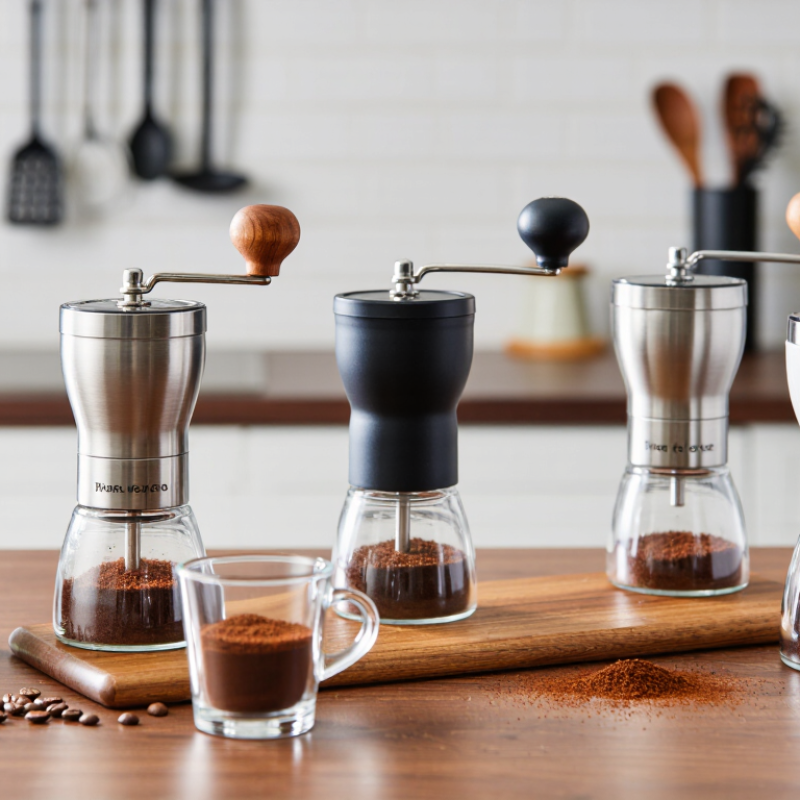
What Conical Burr Hand Grinders Are and How They Work
A conical burr hand grinder crushes coffee beans between two cone-shaped grinding surfaces. One burr stays fixed; the other turns as you rotate the crank. Whole beans move down through the burrs, where their size is reduced before the grounds fall into a collection cup. Simple mechanism.
The grind setting changes the gap between the burrs: a narrower gap generally produces finer grounds, while a wider gap produces coarser ones. Adjustment steps vary by design, so the same setting number may not mean the same particle size on different grinders.
The hand crank supplies the force, making the grinder independent of an electrical outlet. A longer handle can make grinding feel easier, though bean hardness and grind fineness also matter. For a practical check, grind a small dose and look for an even texture; visible mixtures of dust and large fragments may call for adjustment or cleaning.
Burr alignment, worn parts, and trapped grounds can affect consistency. They matter. A conical shape alone does not guarantee a uniform result. Buyers comparing grinders should check the adjustment range, burr material, handle comfort, and ease of disassembly.
Specifications help, but they rarely capture the feel of a full minute of grinding. That detail is easy to overlook.
Key Features That Shape Grind Quality and Usability
For global buyers, a conical burr hand grinder is more than a compact tool. Burr alignment, cutting geometry, and adjustment range all shape the grounds in the cup. A well-made mechanism should turn smoothly, without gritty catches or sudden changes in resistance. Feel the handle rotate. Listen for scraping. Small signs can reveal uneven assembly.
Adjustment steps matter when switching between brewing methods. Espresso usually needs fine, precise changes; a coarse setting should produce visibly larger particles for French press. If the dial has clear clicks or markings, returning to a familiar setting is easier. Still, numbered settings are not universal. Two grinders set to “10” may produce very different grounds. Test with your own beans and brewing method.
Usability affects daily consistency. A stable body, comfortable handle, and secure catch cup make grinding less awkward, especially for larger doses. Check whether the hopper holds enough beans for your routine, and whether the burrs can be cleaned without specialized tools. Stainless steel may feel durable, but weight and grip matter too. Not every detail is perfect: fine grinding can require real effort, and static may leave chaff around the cup. That is worth noticing before purchase. A short hands-on test, when available, often tells more than a long feature list.
How to Evaluate Hand Grinders for Global Buyers
2026 Top Conical Burr Hand Grinders for Global Buyers
How to Evaluate Hand Grinders for Global Buyers
Global buyers should assess a hand grinder as a daily-use tool, not just a set of burrs. The International Coffee Organization estimated world coffee consumption at about 177 million 60-kilogram bags in 2023/24, a reminder that coffee habits vary widely across markets. A grinder intended for espresso needs finer, repeatable adjustment than one used mainly for pour-over. Check how clearly the adjustment steps are marked and whether the setting can be restored after cleaning. Small details matter.
Inspect the burr material, alignment, handle length, and body grip. A longer handle can reduce effort, but it may make packing less convenient. Ask suppliers for grind-size testing across several settings, not only a photo of uniform grounds. Request spare-burr availability, cleaning instructions, and packaging dimensions; these affect service and shipping decisions. For international orders, confirm that product specifications and warranty terms are documented in writing. Reliable records help. One limitation is easy to miss: hand-grinding speed depends on the bean and roast, so published speed claims may not match your customers’ experience. Test samples with the coffees buyers actually use before committing to volume.
Top Conical Burr Hand Grinders to Consider in 2026
Choosing a conical burr hand grinder in 2026 means matching its design to your daily brewing habits. Look for stepped or clearly marked adjustment settings, since repeatable changes make dialing in espresso or pour-over less frustrating. A stable burr set and a rigid central shaft can help produce more consistent grounds. Ask how easily the burrs can be removed and cleaned; trapped coffee oils can dull fresh flavors over time.
The details matter. A textured handle should turn smoothly without slipping, even when beans feel firm. For travel, check the grinder’s weight, body length, and whether the handle detaches securely. A roomy grounds cup saves repeated transfers, but a narrow opening may be awkward to fill. These trade-offs are easy to miss in product photos. For a considered purchase, compare adjustment range, replacement-part availability, and warranty terms, then read testing notes that describe the beans and brew method used. No hand grinder excels at everything. Some are slower than expected, and a finely adjusted model may require more effort than its compact shape suggests. Try before committing, if possible.
2026 Top Conical Burr Hand Grinders for Global Buyers
A practical comparison framework for evaluating manual grinders. Scores are illustrative buyer-priority ratings, not measured product specifications or market research.
Prioritize grind consistency and adjustment control for brewing flexibility; consider capacity, portability, and ease of cleaning according to your routine.
How to Choose a Grinder for Your Coffee and Travel Needs
Choosing a conical burr hand grinder starts with your coffee routine, not its appearance. For pour-over, look for a model with repeatable adjustment steps and burr alignment that keeps grounds reasonably even. For espresso, finer settings and small, predictable adjustments matter more. A grinder may claim broad range, but that does not guarantee easy dialing-in. Ask how adjustments are measured, and check whether replacement burrs or parts are available.
Travel changes the priorities. A compact body, secure handle, and protective case help when your grinder shares space with clothes or a laptop. Weigh it with its accessories, not just the grinder alone. A few hundred extra grams can feel minor at home and annoying after a long walk. Check capacity, too: grinding enough for two cups may require a second fill. That gets old.
Test the grip and crank movement if possible. Smooth bearings reduce effort, but the handle still needs room to turn without knocking your fingers. Stainless steel can handle regular packing, while lightweight materials are easier to carry; neither choice is automatically better. Ask about cleaning access, since fine coffee dust can collect around the adjustment mechanism. I would also allow time to learn a new grinder. My own settings have needed small corrections between beans, and I have occasionally blamed the grinder too quickly. Beans, roast level, and pouring technique all affect the cup.