7 Best Patterned Children Play Mats for 2026
A play mat can turn a bare floor into a small world: a forest path for toy animals, a road for wooden cars, or a soft place for tummy time. In 2026, families have more patterned choices, but attractive prints are only part of the decision. A Patterned Children Play Mat should also suit the room, clean without a struggle, and stay comfortable during everyday play. The details matter.
The American Academy of Pediatrics’ clinical report, “The Power of Play” (2018), describes play as important to children’s learning, development, and well-being. That guidance gives a useful lens for comparing mats: does the design invite imagination, movement, and shared play, or simply look good in a product photo? The U.S. Consumer Product Safety Commission’s toy-related injury reports also reinforce a practical point: safety deserves attention alongside appearance. Check product age guidance, surface grip, seams, and care instructions. Read the label.
This guide compares seven patterned children’s play mats for 2026, focusing on design, materials, comfort, cleaning, and everyday usefulness. Patterns range from calm geometric shapes to vivid roads and animal scenes. A bold print may delight one child and overwhelm another; room lighting and floor color can change the effect, too. No mat is perfect. We’ll note trade-offs where product details or available evidence leave questions, so readers can weigh the options rather than rely on a single “best” claim.
What Defines a Patterned Children’s Play Mat?
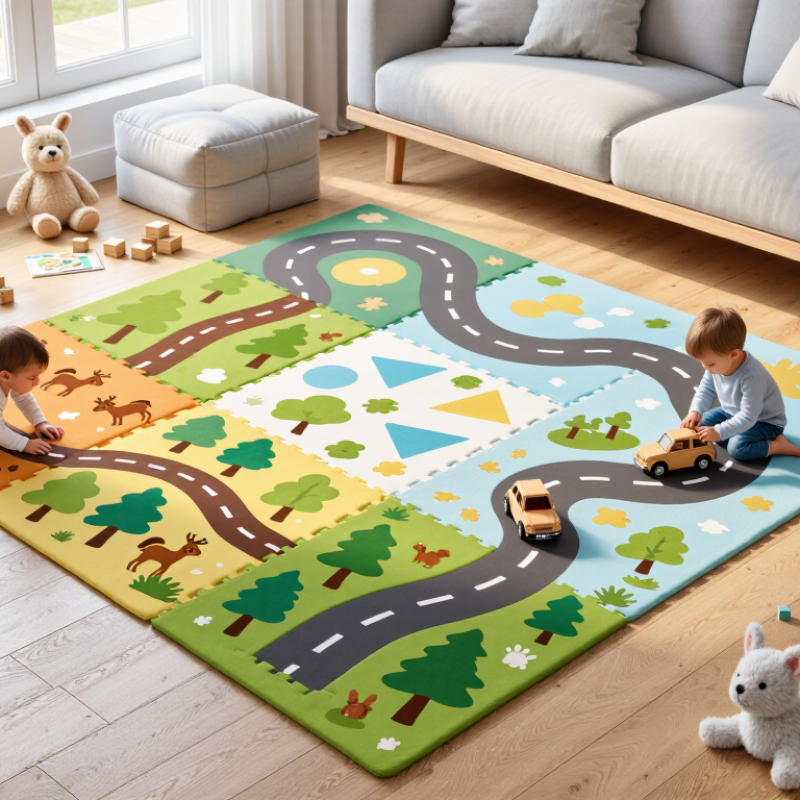
A patterned children’s play mat combines a cushioned surface with repeated images, colors, or shapes. The pattern might feature roads, animals, letters, simple grids, or abstract blocks. It changes the mat’s appearance and can suggest ways to play, such as following a road with a toy car. Not every design needs a lesson. Some are simply cheerful.
A useful definition also considers how the pattern is made and how it holds up in daily use. Printed graphics sit on the surface; raised textures can catch dust or snack crumbs along their edges. That detail matters. Caregivers can check the material, thickness, grip underneath, and cleaning instructions rather than judging by pictures alone. Colors should be easy to see without making a room feel visually crowded, though that balance is personal. Look for curled corners, worn areas, or fading after routine wiping. A bright pattern may be appealing, but it does not prove that a mat is durable or safe. The perfect pattern is hard to define.
How Materials, Safety, and Construction Affect Play Mats
Patterned play mats do more than brighten a room. Their materials affect grip, warmth, cleaning, and how the surface feels under small hands and knees. Soft foam may cushion tumbles, while a thin mat can feel firm over tile. Neither is automatically better. Match thickness and texture to the floor, child, and daily routine. Printed patterns can make play inviting, but check that busy designs do not distract from cracks or peeling edges. Small details matter.
Construction deserves a close look. Press along seams and corners; raised edges can catch little toes, and loose layers may become a tempting thing to pick at. Check the care instructions before cleaning, since harsh scrubbing can wear some printed surfaces. A mat should lie flat on a dry floor, and it should suit the child’s age and play habits. No material stays pristine forever. Even a well-made mat may show dents from a heavy toy or wear near a favorite play spot.
Tips: Compare the mat’s thickness, surface grip, and cleaning guidance before choosing. Inspect seams regularly, especially after spills or frequent folding. If the mat shifts on your floor, reposition it rather than assuming its backing will hold.
How Patterns Can Support Play and Early Learning
Patterns Can Support Play and Early Learning
A striped path can invite a toddler to move a toy car from red to blue, then predict what comes next. Repeating shapes give children simple chances to notice, sort, compare, and explain. These small actions build early mathematical language without turning play into a lesson. The Harvard Center on the Developing Child reports that more than one million neural connections form every second in the early years. That figure describes broad brain development, not the proven effect of any particular play mat. Still, it helps explain why everyday experiences matter.
Choose patterns that are clear at a glance: broad stripes, spaced dots, or a simple sequence of shapes. A caregiver might point, pause, and ask, “What comes next?” Then let the child decide. No quiz required. The UNICEF and LEGO Foundation report Learning through Play describes playful experiences as supporting learning across developmental areas, including language and problem-solving. A mat can offer a useful setting, but it cannot teach on its own. Busy prints may distract some children, and age, mood, and lighting all matter. I may be giving the pattern too much credit; the shared play often does more than the design.
Seven Patterned Children’s Play Mats to Consider in 2026
A patterned play mat can make floor time feel more inviting while giving children details to notice.
In 2026, seven designs worth considering include a road map for toy-car play, an alphabet-and-number print for early recognition, and a woodland scene with animals to spot. An ocean pattern adds fish and waves, while a world map invites simple conversations about places. Geometric shapes offer a less busy look. A muted abstract pattern may suit shared family spaces. Still, check the seams.
The best choice depends on the room and the child’s play habits.
Look for a size that leaves enough space to move, and check whether the underside grips your particular floor. Printed details should remain clear after routine cleaning, but always follow the care instructions. A pale map looks lovely; it may also show crumbs quickly. That matters. If possible, examine the mat in person for surface feel, curled edges, and strong odors before buying.
Patterns can encourage pretend play, but they do not replace adult supervision or a safe, uncluttered play area. A simple design may be easier to live with than the most elaborate one. I would not assume that a cheerful print means the mat is comfortable or durable; those qualities need checking separately.
How to Choose and Care for a Children’s Play Mat
Choosing a children’s play mat starts with the room, not the pattern. Measure the floor space and leave enough room for children to move around its edges. A mat that is too small can bunch up during play; an oversized one may crowd a walkway. That matters.
Consider how the mat will be used each day. For floor play, a cushioned surface can make sitting and crawling more comfortable, but extra thickness is not always better. Check that edges lie flat and the underside grips the floor. Look for clear information about materials and cleaning, rather than relying on broad claims. A lively print can disguise crumbs, which is handy until you need to spot them. Patterns should suit the room, but avoid choosing appearance over practical care.
Shake out loose dust or vacuum gently, then wipe marks with a damp cloth and mild soap if the care instructions allow it. Small details count. Avoid soaking the mat unless its label says it can be washed that way, and let it dry fully before children use it again. Moisture trapped underneath can damage floors or leave the surface slippery. Check seams and corners regularly for lifting, cracks, or wear. A mat may still look cheerful while its edges begin to curl, so replace it when it no longer stays securely in place.