
Who Are the Top Football Fake Turf Suppliers in China?
Choosing Football Fake Turf for a school, training ground, or community pitch involves more than comparing prices. China has many artificial-grass manufacturers and trading companies, but their products and capabilities can vary. A supplier’s polished catalog is useful, not proof. Details matter.
This introduction to the top Football Fake Turf suppliers in China focuses on practical checks rather than unverified rankings. Buyers should compare fiber material, pile height, stitch rate, backing construction, drainage design, and stated UV resistance. These specifications help explain how a surface may perform, but they cannot replace testing under the conditions of a real project. Request samples and technical documents, then confirm that the proposed system suits the site, climate, and expected level of play.
Supplier experience is another useful signal. Ask about manufacturing capacity, quality-control procedures, customization options, export packaging, lead times, and support after delivery. Clear answers are more valuable than broad promises. Where possible, review completed projects and speak with customers who have used the turf over time. Check whether quotations state what is included, such as underlay, installation guidance, or freight. Not every supplier will provide the same level of evidence, and that gap deserves attention. A careful comparison takes time. It can also prevent costly surprises. The following overview helps readers assess Chinese suppliers with informed questions, while recognizing that the best choice depends on project needs and independently verified details.
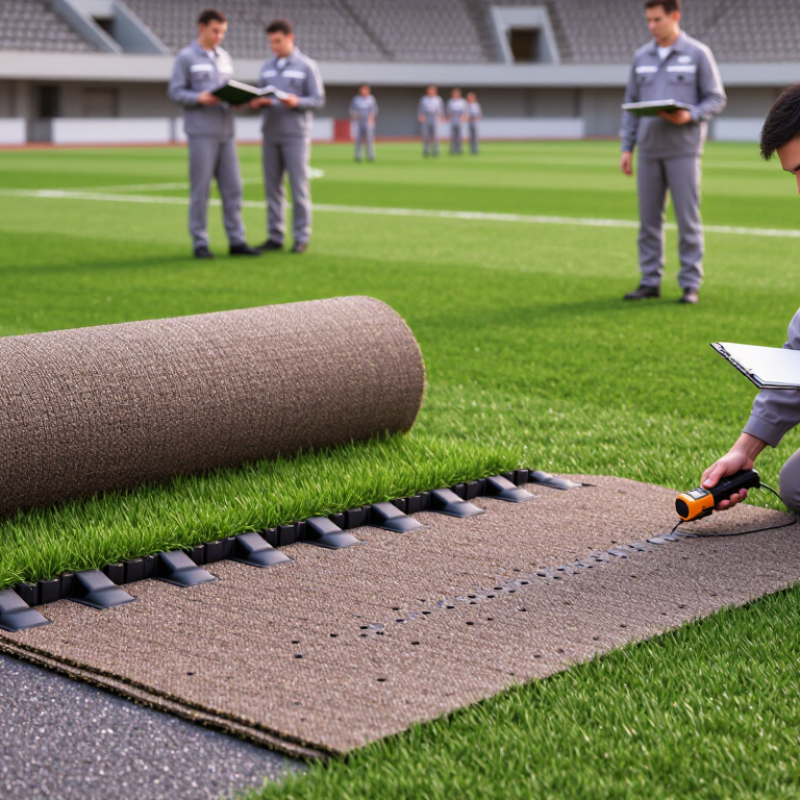
Table of Contents [Hide]
What Is Football Fake Turf and Where Is It Used?
Football fake turf, more accurately called artificial football turf, uses synthetic fibers fixed into a prepared base to create a playable surface. Depending on the system, sand or other infill helps support the fibers and shape how the ball and players interact with the pitch. Grand View Research estimated the global artificial turf market at USD 4.26 billion in 2023, across multiple applications—not football alone. The figure signals broad demand, but it does not show how many pitches are suitable for competitive play. Details matter.
These surfaces appear at professional venues, training grounds, schools, and community pitches, especially where frequent use or limited grass-growing conditions make natural turf difficult to maintain. FIFA’s Quality Programme for Football Turf evaluates factors such as ball roll, shock absorption, and rotational resistance. Those checks help buyers compare field performance, not just fiber color or pile height. A close look at drainage, seams, infill levels, and maintenance records is still essential. A pitch can look excellent in a photo and perform poorly after rain. And artificial turf is not maintenance-free: brushing, debris removal, and periodic infill checks affect how it plays. The trade-off is real. A FIFA test report is useful evidence, but local climate and actual usage should shape the final choice.
Who Are the Top Football Fake Turf Suppliers in China? - What Is Football Fake Turf and Where Is It Used?
| Topic | Dimension | Factual overview | Practical relevance |
|---|---|---|---|
| Definition | Football fake turf | A synthetic sports surface designed to provide a playing surface for football. It commonly consists of synthetic grass fibers tufted into a backing, with infill and sometimes a shock pad beneath the turf system. | The complete system—not just the visible fibers—affects ball behavior, player interaction, drainage, and maintenance. |
| Materials | Grass fibers and backing | Polyethylene is widely used for football turf fibers. The fibers are secured into a backing, which is typically designed to hold the tufts and allow the system to be installed over a prepared base. | Ask suppliers for product data, construction details, and test documentation for the specific turf system being quoted. |
| System design | Infill and shock absorption | Many football turf systems use infill between the fibers. Some installations also include an elastic shock pad below the turf; the exact build-up depends on the intended performance and site design. | Compare the proposed infill, shock pad, base, and drainage design as part of one system rather than evaluating turf carpet alone. |
| Common application | Community and school pitches | Synthetic football surfaces are used at schools, community sports grounds, and training facilities where the site needs a purpose-built sports surface. | The expected user group, playing schedule, local climate, and maintenance capacity should guide the specification. |
| Common application | Clubs and training grounds | Clubs and training venues may use football turf for training or competition, subject to the relevant competition rules and surface requirements. | Confirm the required level of play and any governing-body or competition requirements before choosing a system. |
| Field dimensions | Association football pitch size | Under the Laws of the Game, a standard field of play is 90–120 m long and 45–90 m wide. For international matches, the permitted range is 100–110 m long and 64–75 m wide. | These are field-of-play ranges; the full project footprint also needs space for safety areas, run-offs, access, and site constraints. |
| Quality verification | FIFA Quality Programme | FIFA's Quality Programme for Football Turf includes FIFA Quality and FIFA Quality Pro classifications. Testing and certification relate to defined football-turf requirements; buyers should verify the status of the specific product and installed field. | Request current certificates and confirm their scope, validity, and relevance to the proposed product and project. |
| Supplier evaluation | Manufacturing and quality control | A supplier assessment can cover production capability, quality-control procedures, product traceability, technical documentation, and the ability to provide consistent specifications across an order. | Ask for verifiable records, samples, and a clear specification sheet; do not rely on a ranking or marketing claim alone. |
| Supplier evaluation | Installation and after-sales support | Project delivery may involve site preparation, drainage, base construction, turf installation, line marking, and maintenance guidance. These services may be provided by different parties. | Clarify who is responsible for each project stage, warranty terms, spare materials, and maintenance instructions before placing an order. |
| Important qualification | No universal “top supplier” ranking | Supplier suitability depends on the project specification, evidence of product performance, delivery capability, installation arrangements, and support. A supplier list without comparable, independently verifiable data is not a reliable ranking. | Use the same written specification and evaluation criteria when comparing suppliers in China or elsewhere. |
Note: Project specifications and system components vary. Confirm applicable football rules, certification requirements, local regulations, and site conditions before procurement.