
Choosing among the top Slat Bed Frame manufacturers in China takes more than comparing catalog photos. A frame may look sturdy online, yet creak when its joints loosen or its slats flex under uneven weight. Small details matter. Furniture designer Charles Eames is widely credited with the reminder, “The details are not the details. They make the design.” For bed frames, those details include slat spacing, rail connections, finish quality, and clear load-capacity information.
This guide introduces manufacturers through practical buying considerations, not unsupported rankings. Look for precise product specifications, consistent materials, documented quality checks, and clear communication about customization and production timelines. Ask how slats are secured and whether replacement parts are available. If possible, inspect a sample: run your hand over the finish, check for rough edges, and press gently on the slats. A polished website is useful, but it is not proof of reliable production.
China’s furniture sector includes suppliers with different strengths, scales, and export experience, so one factory will not suit every project. Some buyers need flexible designs; others prioritize repeatable dimensions and stable supply. There is no perfect checklist. Samples can differ from bulk orders, and promises still need verification. The manufacturers featured here offer a starting point for comparison—not a substitute for checking specifications, certifications, references, and product quality before placing an order.
China’s slat bed frame industry sits within a much larger furniture manufacturing network. The National Bureau of Statistics reported that above-designated-size furniture manufacturers earned RMB 655.7 billion in operating revenue in 2023, down 4.4% year on year. This figure covers furniture broadly, not slat beds alone. That distinction matters. It cannot show how many factories specialize in bed frames or compare their production capacity.
In practice, production draws on timber, plywood, metal tubing, fasteners, and finishing materials. Factories may cut and drill slats, smooth their edges, apply coatings, and assemble frames in separate steps. A small variation in slat spacing can affect mattress support, so buyers should examine dimensions, load testing, and inspection records—not just catalogue photos. The sector is not perfectly transparent. Public statistics rarely separate export-focused workshops from domestic suppliers, or reveal defect rates. China’s broad manufacturing scale is clear; the capabilities of any individual factory still need direct verification.

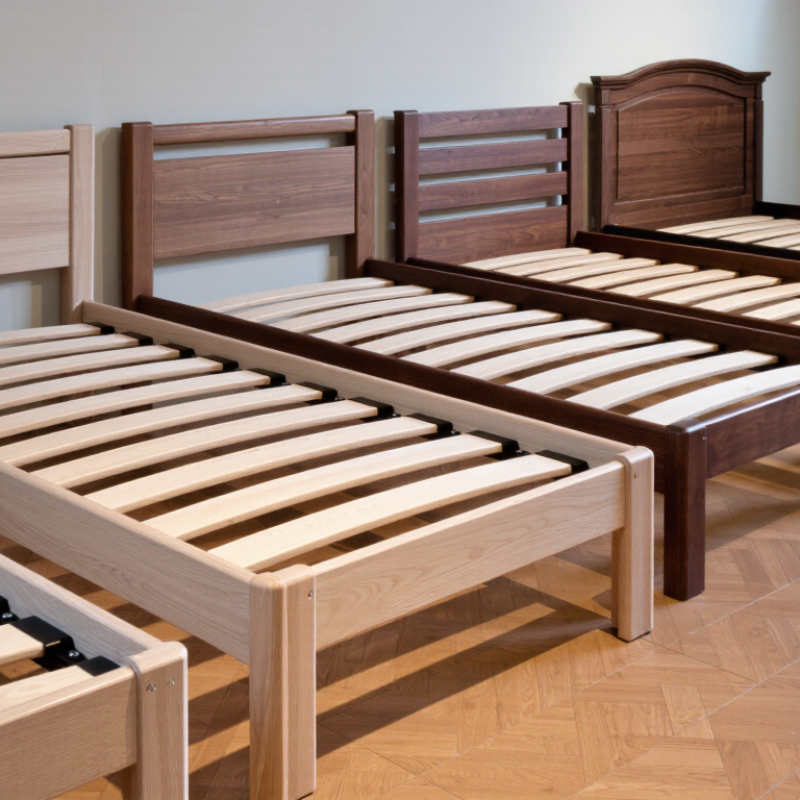
China’s slat-bed frame manufacturers often specialize by material, construction method, and order volume. Solid-wood producers typically offer oak, beech, or rubberwood frames, with visible grain and heavier rails. Engineered-wood specialists can provide consistent panel dimensions and finishes for large furniture programs. Metal-frame makers focus on lighter structures, simple assembly, and compact shipping. Different needs.
China’s National Bureau of Statistics reported furniture-manufacturing revenue of RMB 655.7 billion in 2023, down 4.4% year on year. This broad industry figure does not isolate slat beds, so it should not be treated as a measure of bed-frame demand. It does show the scale of the wider manufacturing base that supports sourcing and component production.
Product specialties matter most in the details. Some suppliers use laminated birch slats for flexible support; others build solid-wood slats with adjustable center rails for wider beds. Buyers should check slat spacing, rail thickness, fastener type, and the finish on hidden surfaces. A polished sample can conceal rough undersides. Requesting load-test records and assembly instructions helps compare suppliers, though these documents may not reflect every production batch. One detail is easy to miss: the frame’s fit depends on the mattress dimensions and the actual slat layout.
Wood species are one way slatted bed frame makers differentiate their products. The chart compares approximate air-dry wood densities, not manufacturer rankings or market shares.
Approximate reference densities: poplar 450, pine 500, birch 650, and beech 720 kg/m³. Actual density varies by species, moisture content, and grade. Reference: USDA Forest Products Laboratory, Wood Handbook.
Slat bed frames commonly use solid pine, poplar, birch, or beech, alongside plywood and laminated wood strips. Solid timber gives each slat a natural grain and firm feel. Engineered strips can offer more consistent dimensions, though glue lines and finishing still deserve inspection. Small details matter.
Designs range from fixed, flat slats to gently curved sprung slats. A central support rail helps limit flex across wider frames, while even spacing supports airflow beneath the mattress. Moisture control matters, too. The USDA Forest Products Laboratory’s Wood Handbook (2021) reports an equilibrium moisture content of about 9.2% for wood at 70°F and 50% relative humidity. That figure is a useful reference, not a guarantee against movement in every room. Timber can still change size as humidity shifts.
Tips: Check slat thickness, spacing, and center supports against the mattress maker’s guidance. Look for smooth edges and secure fasteners. Ask suppliers how wood is dried and stored; the answer may be less clear than expected, so request specific moisture-control details.
Top Slat Bed Frame Manufacturers in China: Production Processes and Quality Standards
For buyers comparing top slat bed frame manufacturers in China, quality begins with material control. A reliable factory checks timber moisture, board thickness, and visible defects before cutting. Slats should have consistent dimensions and smooth edges. Small differences matter. Uneven spacing can affect mattress support and create noise over time. Ask how incoming materials are recorded, not just whether they are inspected.
Production typically includes cutting, sanding, drilling, finishing, and assembly checks. During sampling, confirm that holes align and fasteners fit without forcing them. Finished frames should be checked for sharp edges, loose joints, coating inconsistencies, and stability on a level floor. Request written inspection criteria and test records for the product you are buying. Load tests are useful, but their method and intended use should be clearly stated. A process can still miss a flaw, so keep a sample for comparison with later production.
Tips: Ask for moisture readings, dimensional tolerances, and photos of in-process checks. Test an assembled sample yourself. A polished sample is not the whole story; production batches can vary, and that deserves careful follow-up.
Top Slat Bed Frame Manufacturers in China
How to Assess a Slat Bed Frame Manufacturer in China
A reliable assessment starts with the frame’s intended use, not a polished catalogue. Ask for slat dimensions, material grade, spacing, finish, and the maximum supported load. Request drawings that show joints and center supports. Details matter. If specifications change between a quotation and a sample, ask why before approving production.
Check how the manufacturer controls quality on the factory floor. Ask to see inspection records for moisture content, dimensions, coating, and assembled-frame stability. A practical sample check can reveal loose joints, rough edges, or slats that shift under pressure. Ask how test results were measured and whether the same method applies to production batches. Paperwork helps, but it cannot replace a close look at the product.
Communication is also evidence. A capable team should answer technical questions clearly and flag limits, such as a design that needs extra center legs for a wider mattress. Request a written sample approval process, defect criteria, packaging details, and a realistic production schedule. A factory visit or live video walkthrough may help confirm equipment and workflow, though neither guarantees every batch will match. I would still leave room for doubt: a smooth sample is only one frame, not a full shipment.
Use this framework to compare suppliers without relying on company or brand claims. The scoring weights are suggested buyer-assessment criteria, not industry-wide requirements. Product specifications and applicable regulations should be agreed for the intended market and bed design.
| Assessment Dimension | Evidence to Request | Practical Assessment Criteria | Suggested Weight |
|---|---|---|---|
| Product engineering and specifications | Dimensioned drawings, bill of materials, assembly instructions, and a written specification for each model. | Confirm overall dimensions, supported mattress size, frame construction, slat material, finish, hardware, and packaging requirements. Treat slat spacing and dimensions as product-specific requirements rather than universal values. | 15% |
| Structural testing and durability | Test reports identifying the tested model, test method, sample details, results, and issuing laboratory or facility. | Check whether testing covers the intended bed design and market. EN 1725 is a European standard concerning beds and mattresses; confirm the applicable edition and requirements with the buyer or testing body. Do not assume a report for one design covers every model. | 15% |
| Materials and component control | Material specifications, supplier records for key components, finish details, and any relevant material test reports. | Verify the species or grade claimed for wood components, the material used for metal parts, and the specified finish. Compare production materials with the approved sample and purchase specification. | 12% |
| Quality management and inspection | Quality procedures, inspection records, defect-handling process, and examples of batch or lot traceability. | Ask how incoming materials, in-process work, finished goods, and packaging are checked. Agree inspection criteria and any sampling plan in writing; ISO 2859-1 provides sampling schemes indexed by acceptance quality limit, but the buyer and supplier must agree how to apply them. | 12% |
| Customization and change control | Prototype process, sample approval records, tooling or drawing revision controls, and confirmation of production lead times for changes. | Confirm which dimensions, finishes, materials, slat arrangements, and packaging options can be customized. Require approval of production samples and written authorization for specification changes. | 10% |
| Market compliance and documentation | Product-specific test reports, labeling and instruction drafts, and certificates relevant to the destination market. | Check requirements for the destination country and intended product use. Verify that certificates are current, issued by an appropriate organization, and applicable to the product and manufacturing scope; a general certificate is not proof that every product complies. | 10% |
| Production capacity and delivery planning | Production schedule, capacity information for the requested order, material procurement plan, and shipment schedule. | Assess whether the supplier can support the required order quantity and delivery window. Confirm production milestones, inspection timing, packaging readiness, and the named delivery terms in the quotation or contract. | 8% |
| Responsible sourcing and environmental claims | Wood-source documentation and certificates supporting any stated sourcing or environmental claims. | For FSC-related claims, check the certificate holder, scope, validity, and whether the relevant products and transaction documents are covered by chain-of-custody requirements. Do not treat an unsupported logo or statement as verification. | 6% |
| Communication and technical support | Written responses to technical questions, sample feedback records, and a clear contact and escalation process. | Evaluate whether answers are specific, consistent with the drawings and quotation, and provided in time to support sampling, production approval, and issue resolution. | 6% |
| Commercial transparency | Itemized quotation, payment terms, packaging details, warranty terms, and written policies for nonconforming goods. | Compare quotations using the same product specification, quantity, packaging, delivery basis, and inspection requirements. Clarify exclusions and responsibility for rework, replacement, or other agreed remedies. | 6% |
| Total suggested assessment weight | 100% | ||
Fast, modern and
At your fingertips
Tremain´s Blaze fast program
Was created for customers
That need product FAST!
Download catalog
Blaze Catalog