How to Choose Office Furniture Design in 2026?

Choosing office furniture design in 2026 requires more than following attractive workplace trends. A polished desk may photograph well, yet fail during a long afternoon of focused work. Employees notice wobbling tables, harsh edges, poor cable control, and chairs that create pressure points. They also notice whether a workspace feels adaptable, calm, and genuinely usable.

Furniture designer Charles Eames once said, “The details are not the details. They make the design.” His words remain useful when evaluating modern offices. A strong office furniture design should support posture, movement, collaboration, privacy, and technology without creating visual clutter. Height-adjustable desks, supportive seating, acoustic screens, and modular storage can help, but only when they match real working habits. Measure the room. Observe how people move. Test the chair before ordering hundreds.

The decision is not always perfect.

A fashionable material may scratch easily. A highly flexible layout may feel unsettled. Sustainable furniture can also require careful budget planning, maintenance, and verified product information. These trade-offs deserve honest review. Look for credible testing, clear warranty terms, repair options, and responsible material documentation. Consider accessibility from the beginning, not after installation.

This guide explores how to balance appearance, comfort, durability, and workplace performance in 2026. It focuses on practical selection rather than empty novelty. The best choice may not be the loudest design. It may be the quiet chair, stable table, or reusable partition that helps people work better every day.
How to Choose Office Furniture Design in 2026?

Define Work Modes with Gensler’s 2024 Workplace Survey: Office, Hybrid, and Remote

How to Choose Office Furniture Design in 2026?

A 2024 workplace survey highlights three practical work modes: office, hybrid, and remote. Each mode needs a different furniture response. Office teams need shared desks, ergonomic chairs, and quiet rooms for focused tasks. Hybrid teams need flexible stations that support quick changes between individual and group work. Remote workers need compact desks, adjustable seating, and reliable lighting for smaller rooms.

Start with behavior, not appearance. Measure how people use the space during a normal week. Notice where meetings happen, where cables collect, and which chairs remain empty. In one office project, I placed large collaboration tables near the entrance. They looked welcoming, but employees wanted quieter corners. The layout failed.

Small details matter. Choose desks with simple height adjustment and enough depth for a screen, notebook, and personal items. Use mobile storage when teams change seats regularly. Add acoustic screens around shared work areas, but do not isolate every person. Hybrid workers need clear booking rules and furniture that resets easily. A clean desk should take minutes, not an entire afternoon.

Remote work requires restraint. Oversized furniture can overwhelm a bedroom or dining area. Foldable surfaces, supportive chairs, and soft task lights often work better. I still question whether every remote worker needs a dedicated office. Sometimes, a well-designed corner is more realistic. Furniture decisions should reflect actual routines, even when those routines remain imperfect.

Set Space Standards Using BIFMA Planning Benchmarks and 2026 Density Data

How to Choose Office Furniture Design in 2026?

Office furniture decisions should begin with measured workplace behavior, not attractive layouts. Use BIFMA planning benchmarks as a practical reference for workstation dimensions, seating performance, durability, and safe clearances. These benchmarks support better decisions, but they do not replace local accessibility or building requirements. Check circulation paths carefully. Aisles should feel comfortable when two people pass each other. Storage doors should open without blocking movement.

For 2026 planning, test several density scenarios instead of trusting one ratio. A useful starting range is 120 to 180 usable square feet per assigned person. Compare that range with badge data, attendance patterns, meeting-room demand, and remote-work schedules. For example, thirty desks may serve forty-five employees if attendance is genuinely staggered. That assumption needs evidence. Add quiet rooms, shared tables, and small meeting settings around real work patterns. Avoid filling every spare corner with furniture. Empty space can improve focus, access, and future flexibility.

Choose adjustable desks, supportive task chairs, and modular storage where work changes frequently. Specify materials that can handle daily movement, cleaning, and occasional misuse. I have seen efficient plans fail because acoustic panels were treated as decoration. Noise travels farther than expected. Recheck the plan after a pilot installation. A neat density ratio can still produce a poor office. That is the uncomfortable part.

Select Ergonomic Desks and Chairs Following ANSI/HFES 100 and OSHA Guidance

How to Choose Office Furniture Design in 2026?

Office furniture should support movement, not freeze workers into one posture. ANSI/HFES 100 recommends designing computer workstations around user dimensions and neutral body alignment. OSHA guidance also encourages adjustable chairs, suitable monitor placement, and adequate space for keyboards and pointing devices. The goal is practical: feet supported, shoulders relaxed, and elbows close to the body.

A chair needs adjustable seat height, lumbar support, and controlled recline. Desk height should allow forearms to remain nearly level while typing. The monitor should sit directly ahead, with its top near eye level for many users. It should also be about an arm’s length away.

Small details matter. A sharp desk edge can press against the wrists. A poorly placed laptop can pull the neck downward for hours.

27%

The U.S. Bureau of Labor Statistics reported that musculoskeletal disorders represented about 27% of private-industry days-away-from-work cases in 2023.

That figure makes ergonomic planning more than a design preference. Still, furniture alone cannot solve every problem. OSHA emphasizes work practices, posture changes, and short breaks.

I have seen adjustable chairs ignored when controls are confusing. That is a design failure, not a worker failure. A useful 2026 layout should invite users to change positions, leave legroom, and adjust equipment without asking for technical help. Erotic?

Specify Low-Emission Materials Against EPA’s 2–5× Indoor Pollution Finding

How to Choose Office Furniture Design in 2026?

Office furniture should support clean air, not quietly pollute it. The U.S. Environmental Protection Agency reports that indoor pollutant levels can be two to five times higher than outdoor levels, and occasionally much higher. New desks, cabinets, and acoustic panels may release volatile organic compounds through adhesives, coatings, and composite wood. Therefore, specify low-emission materials before choosing colors or decorative details.

Ask suppliers for recent chamber-test results, not vague “eco-friendly” claims. Products tested under the California Department of Public Health Standard Method V1.2 can provide useful emissions data for furniture and interior materials. Favor water-based finishes, formaldehyde-reduced panels, powder-coated metal, and solid surfaces with documented content. Ventilated storage also matters. A sealed cabinet can trap odors beside a workstation.

Look closely at the first weeks after installation. Open cartons in a ventilated area, keep unpacked furniture away from occupied rooms, and record odors or irritation complaints. EPA guidance supports source control and increased ventilation, but ventilation alone is not a complete fix. I would not accept one certificate as absolute proof of safety; testing methods, batch changes, and installation conditions can differ. Budget limits are real, yet replacing poorly selected furniture later costs more than checking emissions before purchase. The most attractive design may still be the wrong choice if workers breathe its chemistry every day.

How to Choose Office Furniture Design in 2026? — Specify Low-Emission Materials Against EPA’s 2–5× Indoor Pollution Finding
Material or Component Typical Indoor-Emission Profile Key Specification for 2026 Durability and Maintenance Best Office Applications Selection Priority
Solid wood with a low-emitting finish Generally low after curing
Emissions depend mainly on the coating, sealant, and adhesive rather than the wood itself.
Request the finish’s VOC information and a stated curing period. Prefer water-based or otherwise documented low-emitting coatings. Long service life when protected from prolonged moisture. Requires periodic cleaning and occasional refinishing. Desks, meeting tables, storage fronts, and executive work surfaces. High, when finish and adhesive documentation is available.
Metal with powder coating Very low after manufacture
The metal substrate is not normally a significant VOC source in occupied spaces; emissions may come from coatings, lubricants, or attached components.
Specify powder-coated surfaces and verify that added panels, adhesives, and edge treatments are also low-emitting. High resistance to impact, abrasion, and routine cleaning. Check for corrosion protection in humid areas. Desk frames, filing systems, shelving, lockers, and task-support structures. High for structural components and frequently handled surfaces.
Glass Very low
Glass is generally inert indoors; emissions can originate from films, printed graphics, sealants, or frame adhesives.
Specify low-emitting sealants and adhesives. Use safety glass appropriate to the application. Easy to clean and resistant to stains, but vulnerable to edge damage, fingerprints, and impact. Conference tables, privacy screens, partitions, and visual dividers. High for tabletops and partitions when edge materials are documented.
Particleboard, MDF, or plywood composite wood Variable to elevated
Composite wood can be a formaldehyde source, especially when new, poorly sealed, or manufactured without compliant emission controls.
Require documentation of compliance with applicable formaldehyde limits under EPA TSCA Title VI or equivalent requirements. Seal exposed edges and cut-outs. Cost-effective and dimensionally consistent, but vulnerable to moisture at unprotected edges and fastener pull-out. Worktops, modesty panels, cabinets, shelving, and acoustic enclosures. High scrutiny; do not specify solely by appearance or price.
Low-emitting laminate over composite wood Usually moderate to low when sealed
The laminate can reduce exposed surface area, but emissions may continue from the core, joints, and unfinished edges.
Confirm the core’s formaldehyde compliance, seal all edges, and request whole-product or component emission testing where available. Good resistance to abrasion and stains. Damaged edges should be repaired promptly to limit moisture penetration. High-use desks, reception counters, workstations, and storage units. High, particularly for large quantities installed at one time.
Upholstery fabric and acoustic textiles Variable
Emissions may arise from backings, dyes, stain treatments, flame retardants, adhesives, and the substrate beneath the fabric.
Request material safety information and low-emitting product documentation. Avoid unnecessary chemical treatments where performance requirements permit. Performance depends on abrasion resistance, cleanability, lightfastness, and seam construction. Replace heavily worn covers. Task chairs, lounge seating, acoustic panels, booths, and screens. Medium to high; evaluate the complete assembly rather than the face fabric alone.
Polyurethane seat foam Variable, especially when new
Foam formulation, additives, cover materials, and adhesives influence initial emissions and odor.
Request product-level VOC or indoor-air-emission test results when available. Allow off-gassing in a ventilated area before occupancy. Comfort and resilience decline with use. Select foam density and replacement access according to expected duty cycle. Task chairs, visitor chairs, sofas, and collaborative seating. Medium; prioritize test evidence and replaceable components.
Natural cork or linoleum surface Generally low to moderate
The surface may be low-emitting, while adhesives, backing layers, and protective coatings can affect indoor emissions.
Specify low-emitting adhesive and finish systems. Verify that the complete installed assembly has emission documentation. Comfortable to touch and repairable in some applications. Protect from standing water and harsh chemicals. Desk inlays, pinboards, cabinet fronts, work surfaces, and collaborative tables. Medium to high when the adhesive system is clearly specified.
Recycled plastic components Material- and process-dependent
Emissions vary by polymer, additives, recycled feedstock, colorants, and manufacturing process.
Request product-specific VOC testing and identify the polymer and additives. Do not assume recycled content automatically means low emission. Often moisture-resistant and easy to clean. UV stability, scratch resistance, and repairability vary by polymer. Chair shells, cable-management parts, privacy screens, and accessory components. Medium; verify both emissions and long-term performance.
Specification rule: Indoor concentrations can be higher than outdoor concentrations, and EPA notes that indoor pollutant levels are often two to five times higher outdoors, with some pollutants occasionally much higher. Because emissions vary by formulation and installation, use whole-product documentation, not material names alone. Prioritize low-emitting adhesives, sealants, coatings, composite-wood cores, foams, and upholstery assemblies; ventilate newly installed furniture before regular occupancy where practical.

Validate Flexibility, Accessibility, and ROI Through a Post-Occupancy Pilot

How to Choose Office Furniture Design in 2026?

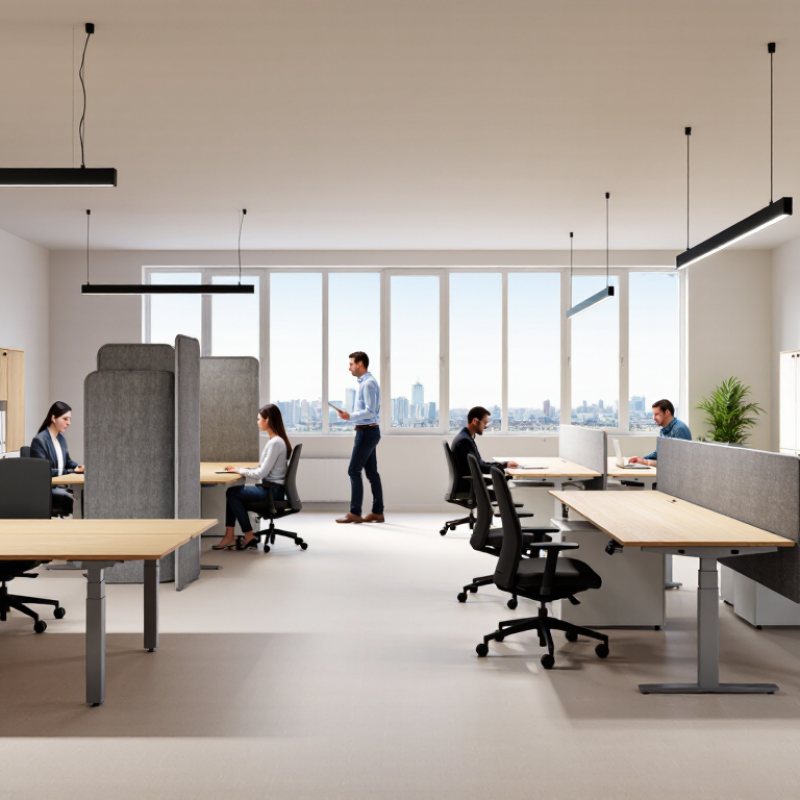
A post-occupancy pilot reveals whether furniture performs beyond showroom impressions. Test one or two representative zones for four to six weeks. Observe how teams adjust desks, move screens, and share meeting surfaces. Record setup time, unused seats, noise complaints, and repair requests. Short surveys can measure comfort, focus, and perceived control. Include different body types, mobility needs, work styles, and job functions. Accessibility should be observed in practice, not assumed from product specifications.

Tips: Photograph layouts before and after use. Ask users where movement feels restricted. Check clear routes, reachable controls, lighting, and chair adjustments. Invite an accessibility specialist to review the space. Small details matter.

Calculate ROI with evidence from the pilot. Compare furniture costs with utilization, relocation time, maintenance, absence patterns, and employee feedback. A flexible layout may reduce future renovation costs, but that result needs local data. Do not treat every positive comment as proof. Some participants may respond politely, while quiet users remain uncomfortable. Our pilot experience often shows that the first layout is too optimistic. Teams need more storage than expected, or collaboration areas become noisy. Revise the plan, test it again, and document every change. Reliable decisions come from repeated observation, transparent assumptions, and measurable trade-offs.

How to Choose Office Furniture Design in 2026?

Validate flexibility, accessibility, and ROI through a post-occupancy pilot.

The pilot uses measurable decision thresholds rather than brand comparisons: support at least 90% of common work modes, achieve full accessible-route compliance, reach 80% employee satisfaction, and recover the furniture investment within 36 months.